
Instrumentation Engineer
a guide to: Career
What is a Instrumentation Engineer?
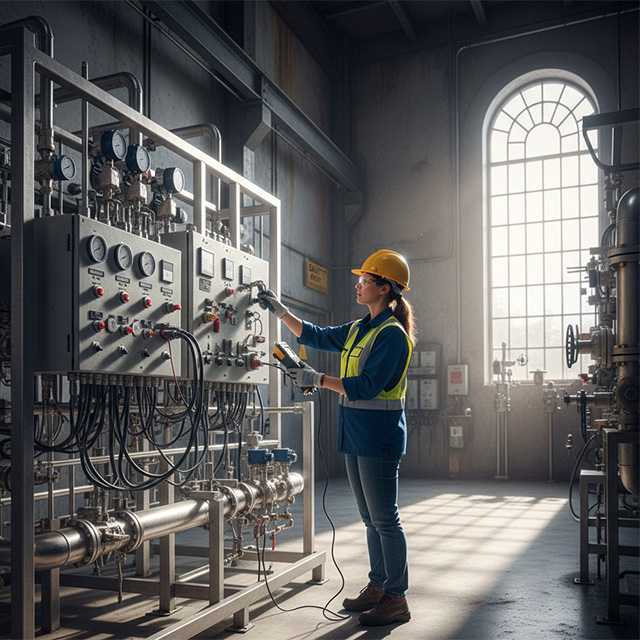
An Instrumentation Engineer designs, installs, calibrates, and maintains measurement and control systems using sensors, transmitters, and automation technologies to ensure accurate monitoring, control, and safe operation of industrial processes.
Why is a Instrumentation Engineer important?
Instrumentation Engineers are the "eyes and ears" of a modern factory. They provide the critical sensory data needed for automation, ensuring that machines operate within safe limits while maximizing production speed and minimizing human error.
- Process Control:
- Regulates critical variables such as pressure, temperature, flow, and level to maintain consistent product quality and stable operations.
- Safety Assurance:
- Designs fail-safe mechanisms and emergency shutdown systems to prevent industrial accidents, leaks, and hazardous situations.
- Operational Efficiency:
- Improves plant productivity by minimizing downtime, energy consumption, and material waste through real-time monitoring and control optimization.
- Data Intelligence:
- Enables Industrial Internet of Things (IIoT) by integrating sensors, controllers, and analytics for data-driven decision-making and predictive maintenance.
As industries shift toward Industry 4.0, these engineers are indispensable for creating "smart" environments that balance high-speed output with stringent environmental and safety compliance.
Education Pathways
Option 01
Stream

Important Subjects
| # | Subject |
|---|---|
| 1 | Sensors & Transducers – Study of devices that convert physical parameters such as temperature, pressure, flow, and displacement into measurable electrical signals. |
| 2 | Process Control – Mathematical modeling and control of industrial variables to ensure system stability and optimal performance. |
| 3 | Industrial Automation – Programming and application of PLC, SCADA, and DCS systems for automated industrial operations. |
| 4 | Analytical Instrumentation – Measurement of chemical composition and properties of liquids and gases in industrial processes. |
| 5 | Signals & Systems – Analysis of continuous and discrete signals and their behavior in physical and control systems. |
| 6 | Control System Design – Designing feedback and feedforward control loops to maintain desired system output. |
| 7 | Digital Electronics – Fundamentals of logic circuits, microprocessors, microcontrollers, and digital system design. |
| 8 | Biomedical Instrumentation – Application of sensors and measurement systems in medical diagnosis and healthcare equipment. |
| 9 | Microcontrollers – Programming and interfacing microcontroller-based embedded systems for real-time control applications. |
| 10 | Optical Instrumentation – Use of optical and fiber-optic systems for precision measurement and data transmission. |
| 11 | Data Acquisition Systems (DAQ) – Converting real-world analog signals into digital data for monitoring, analysis, and control. |
| 12 | Measurement Techniques – Industrial calibration standards, accuracy, precision, error analysis, and measurement methodologies. |
Where to study?
Career Progression for a Industrial Designer
Qualification Levels:
- B.Tech/B.E. for entry roles;
- M.Tech/M.E. or certifications add advantage.
Role Levels & Growth:
- Entry - Instrumentation Engineer / Trainee - Plant operations
- Mid-Level - Control & Instrumentation Engineer - System optimization
- Senior - Senior Instrumentation Engineer - Project leadership
- Lead - Instrumentation Lead / Manager - Team & plant leadership
- Expert - Automation Consultant / Architect - Strategic automation
Further Opportunities:
- Automation Engineer
- Senior Engineer
- Lead Engineer
- Project Manager
- R&D, Industry 4.0
Sectors Offering
- Oil & Gas and Petrochemicals: Designing, installing, and maintaining instrumentation systems for refineries, pipelines, offshore platforms, and petrochemical plants.
- Power Plants & Energy Sector: Automation and control of thermal, nuclear, hydro, solar, and wind power generation systems for safe and efficient operations.
- Chemical & Process Industries: Monitoring and controlling complex chemical reactions, flow processes, pressure, and temperature using advanced control systems.
- Pharmaceuticals & Biotechnology: Precision instrumentation for sterile manufacturing, batch processing, quality control, and regulatory compliance.
- Manufacturing & Industrial Automation: Implementing PLC, SCADA, DCS, robotics, and smart factory solutions to improve productivity and reduce downtime.
- Steel, Cement & Heavy Industries: Controlling large-scale industrial processes such as furnaces, kilns, rolling mills, and material handling systems.
- Water Treatment & Utilities: Instrumentation and automation of water supply, wastewater treatment, desalination plants, and distribution networks.
- Aerospace & Defense: Developing high-precision control, navigation, testing, and monitoring systems for aircraft, missiles, and defense technologies.
Expected Salary
Entry Level
- ₹3.5 - ₹6 LPA
Mid-Level
- ₹7.0 - ₹14.0 LPA
Senior Level
- ₹18.0 - ₹30.0 LPA
International
Entry Level
- $60,000 - $75,000 per annum
Mid/Senior Level
- $90,000 - $210,000 per annum
Design by Find Right Path